
3 Media Tactics the Right Will Use to Undermine Brandon Johnson
Here’s what to look out for in the coming months.
This is a Mockup of Substack using CiteIt.net.
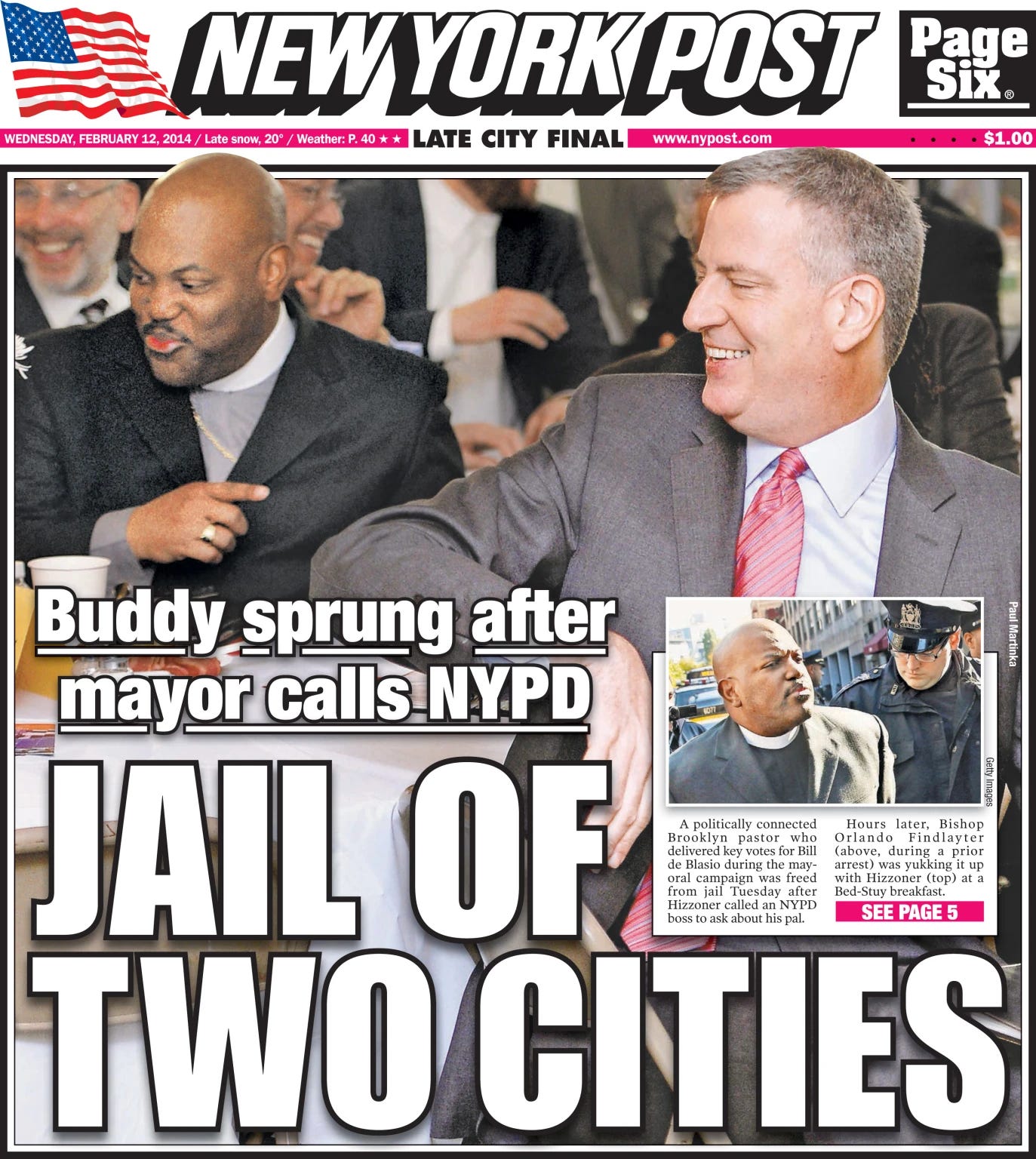
February 11, 2014: New York Post reports that de Blasio intervened to get a friend and political ally, Bishop Orlando Findlayter, out of jail early after he was arrested on warrants stemming from an arrest at a protest. The report cites a “police source,” and also quotes the NYPD police union spokesperson expressing outrage at the incident. This information almost certainly was leaked by elements within the NYPD who were privy to the overnight detaining of Findlayter.
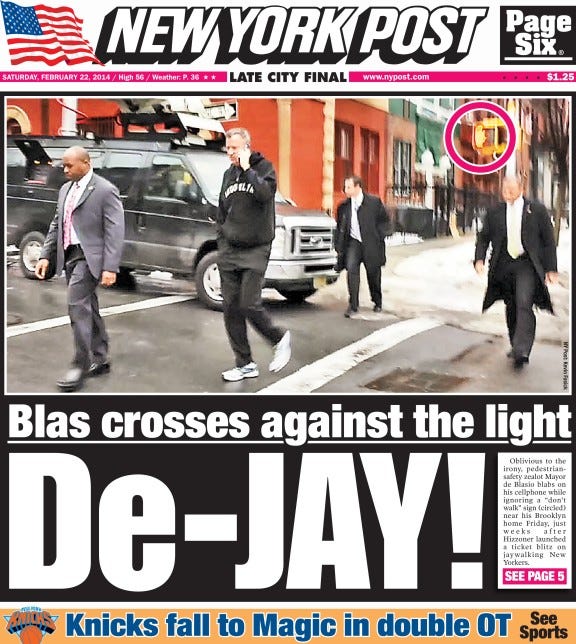
February 20, 2014 and February 21, 2014: In back-to-back stories supposedly showing the new mayor as a massive hypocrite, the New York Post and CBS News manufactured a scandal about de Blasio violating traffic laws just two days after he announced his “Vision Zero” public safety plan. The dual stories, perfect gotcha tabloid fodder, are not really stories about de Blasio breaking traffic rules—they’re stories of the NYPD doing so because they run his security detail and thus control his movements.
The first story, broken by CBS News, follows de Blasio’s mayoral caravan through numerous red lights. The headline, “De Blasio’s Caravan Caught Speeding, Violating Traffic Laws Embarrassment Comes Just Days After Mayor Announced New Traffic Safety Initiative,” blared charges of hypocrisy. But de Blasio, of course, didn’t drive his own car—the NYPD did. The next day, the New York Post posted a story about de Blasio supposedly jaywalking. The headline, “De Blasio jaywalks as he preaches road safety,” is a perfect viral story of elite law-breaking and double standards. In the story, de Blasio mentions that he was following his security detail’s orders of when and where to go, which the Post scoffs at. But the specifics aren’t important; the point is to make de Blasio look like an aloof hypocrite. In these two stories, the NYPD violates traffic laws, but somehow the blame is put in de Blasio with the NYPD winking along.
This is just a week’s worth of stories. In isolation, these aren’t blockbuster scandals, but they’re designed to intimidate and derail and distract an elected officials agenda in their early weeks. The point is to let officials know that police and their media allies can fuck with you whenever they want about the most minor thing.
The police rank and file would, less subtly, create media spectacle throughout de Blasio’s tenure by frequently turning their backs on the mayor while he was speaking at funerals for officers who died in the line of duty. In February 2020, Sergeants Benevolent Association union rep, Ed Mullins, openly “declared war” on de Blasio, telling reporters,
“We’re going to start to expose what really goes on in the NYPD -- what really goes on inside City Hall
. [The mayor is] either going to get in front of this, or this is going to get to a point that it’s not gonna be good." (Earlier this year, Mullins pled guilty to stealing more than $600,000 in union funds and will be sentenced to 33 to 41 months in federal prison).
This mode of threats and scandal-manufacturing would continue in much more serious ways. One especially sleazy example was in December 2014, when the supposedly sealed minor arrest records pertaining to a de Blasio aide's 17 year-old son, who was charged with misdemeanor trespassing, were leaked to the New York Post. All the sources for the story are explicitly—or obviously—the NYPD. (I chose not to link to the story because the subject was under age at the time.) In subsequent years, the NYPD would get even more brazen when targeted by meaningful police reform. During the early days of the 2020 George Floyd protests, the NYPD union, Sergeants Benevolent Association, infamously doxed de Blasio’s 25-year-old daughter, tweeting out her arrest record and address.
Police-curated stories were a common feature of the tenure of de Blasio, who often butted heads with union leadership, despite doing a 180 and backing most police initiatives. But to the hardcore reactionary elements within the police department, anything short of categorical deference to police union whims is a betrayal worthy of retaliation. Even his decidedly pro-police replacement, Eric Adams, wasn’t going to make the same mistakes de Blasio did, choosing to hire his brother as the head of his security for the first year with NYPD reporting directly to him. The story was presented in the media as one of corruption, but anyone with a passing knowledge of the department’s relationship to elected officials knew it was a common-sense precaution.
Given the CPD is likely running Johnson’s security detail, and the CPD union has been vocally threatening “blood in the streets” if Johnson were to be elected, one could expect to see similar stories trickle out from Chicago media. The situations are not entirely the same for many reasons, but given the widespread and open disdain for Johnson by CPD sources and rank and file, it makes sense to keep an eye out for this genre of police-curated media trolling. Again, in isolation, none of these mini-scandals are a backbreaker, politically, but they’re not really designed to be either: They’re designed to intimidate and send a message for electeds to get in line.
2. CPD Blue Flu tantrums
Indeed, Johnson is already being blamed for police indifference before he has even taken office. The Chicago Tribune reported on April 20, in lurid detail, how police refused to intervene last week while two young people were being beaten by a mob of teenagers in the city’s downtown tourism district.
After four different groups of police officers supposedly refused to help, the victims
“drove to the 1st District police station on the Near South Side
,” the Tribune reports. “When they got there, the desk sergeant told Dennis the attack happened because Chicagoans elected Brandon Johnson as mayor.”
This is a popular tactic by police: basically stop intervening to prevent ongoing crime, or stop investigating or attempting to solve crimes, to punish progressive mayors, DAs, or other electeds. Researchers show a meaningful shift in enforcement before and after the recall of San Francisco’s reform DA. During the 2020 George Floyd protests, police departments overtly announced “blue flus” in Atlantia, New York, Baltimore, and many other jurisdictions.
As The Post notes,
“Throughout the 1960s, ’70s and ’80s, the blue flu was a ubiquitous and highly effective tactic in Baltimore, Memphis, New Orleans, Chicago, Newark, New York
.”
Their general argument is, “If you hate the police so much, see what life without us is like.” And the media zeroes in on sensational examples of such non-enforcement—the kinds of examples designed to stoke fear. Left out of this coverage are questions about whether, overall, less policing in its own right leads to a reduction of harm. Do fewer stops and interactions and arrests have the net effect of improving the wellbeing of Chicagoans, not skewing for a small minority of sensational examples? Such questions are not meaningfully explored, much less answered.
The other problem with this line of reasoning is the idea of transferring funds from the police into non-carceral crime prevention measures requires the second part of the equation. Without parallel efforts at prevention and de-escalation, cities simply shovel billions into police departments to do nothing but play candy crush on their phones. It’s not as if street crime is made up—it’s that there exists are other, less violent and racist, means at social interventions. Without these interventions, the absence of any social intervention is designed to punish elected officials with more instances of crime––especially high-profile episodes of crime––until they cave and give the police union reps everything they want.
3. Selective, sensational crime reporting
Given that “Chicago” is already a right-wing watchword thrown around on Fox News dozens of times a day, both local and national media are going to try to make Johnson the face of “crime” in Chicago, regardless of whether the trends track down or not. To achieve this, we will see many of the same tactics that have been used against reform prosecutors throughout the country, namely sensationalist and selective “crime” reporting that was leveled against former San Francisco DA Chesa Boudin.
Media Matters’ Gideon Taaffe detailed how both local and national right-wing media inflated, lied about, and demagogued the subject of crime over and over again to build momentum to recall Boudin. Similarly dishonest reporting in the New York Times pre-pandemic targeted modest reform DAs and the then-recently passed bail reform bill. As I noted in The Appeal at the time, local Times reporters would frequently reverse engineer “crime spike” stories by arbitrarily zooming in on certain precincts, districts and boroughs, frequently moving the goalpost of how we measure changes in crime to paint a dire picture for their wealthier readership. The previous year in 2019, Watkins reported a “murder spike” in Brooklyn. As I noted at the time:
[NYT’s Watkins told] readers that “
“as of March 24, the borough had recorded 28 homicides so far this year, compared with 17 in the same period last year, a 64 percent increase.” The upward trend no doubt shocked thousands of Times readers. But, by August, murder in Brooklyn was actually down 12 percent year-to-date. Once 2019 was over, the total Brooklyn murder rate was up by a total of two, 100 from 98––hardly the “64 percent increase” readers were warned about in the spring..
These types of nickel-and-dime “crime spike” stor
I manually mocked-up demo articles from selected Substack authors to demonstrate how Substack would look if it used CiteIt's contextual citations:More Substack articles: