Writer's FAQ: Frequently Asked Questions
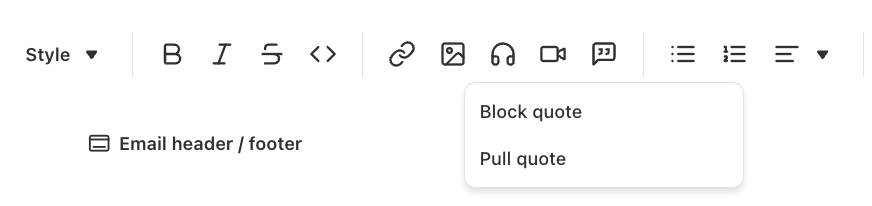
How would CiteIt work if Substack adopted it?
After CiteIt |
Before CiteIt
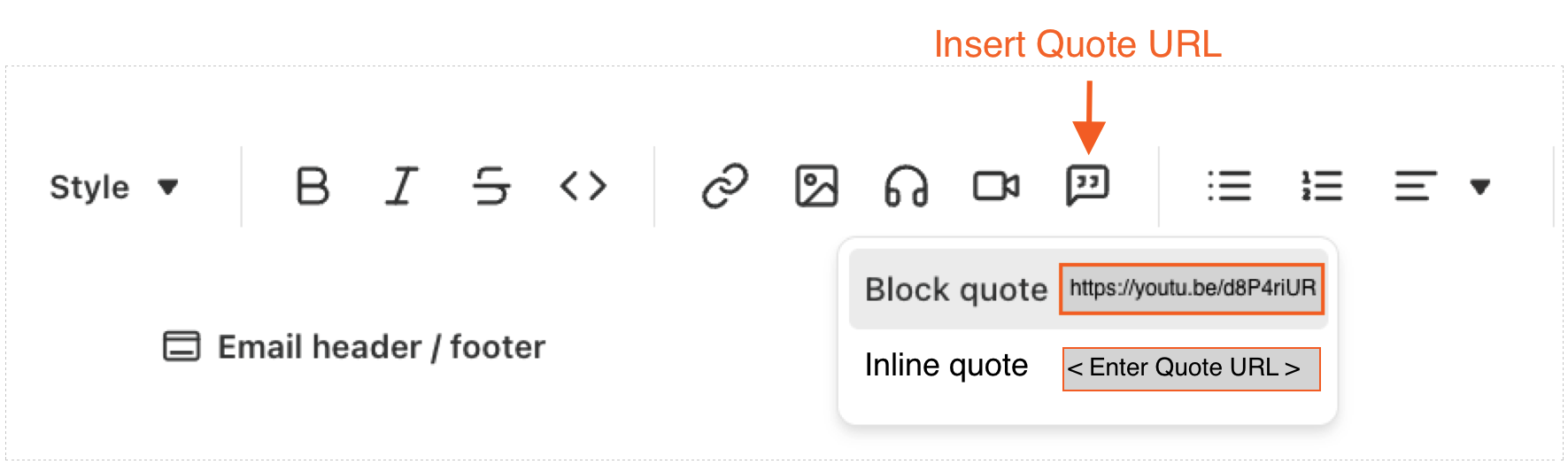
Proposal: add a text box to Editor and pass the Quote URL to CiteIt.
Process:
- The writer would highlight the text they want to quote, just like they do when they create a traditional link.
- The writer copies and pastes the URL of the quoted source or YouTube video into Substack Editor's text box.
- When the writer publishes the article, Substack would use the CiteIt App to lookup the source url that the writer entered in the text box to find the 500 characters before and after the quote.
- CiteIt would save the contextual data to a json file
- When the reader visits the page, CiteIt uses the contextual data file to construct the contextual inspection popups or blockquotes.
Can you locate the source of any quote?
- No, CiteIt only locates the context of quotes whose source has been identified by the author with a URL.
- If an author chooses not to identify a source, CiteIt will not attempt to locate it.
"How much extra work is this for writers?"
- If you already have your sources open, it's a simple copy-paste of the URL into the menu text box. The system does the heavy lifting of pulling the context from the source page.
"Does this break the flow of my writing?"
- It actually cleans it up. Instead of bulky sentences, such as .. 'according to a PDF from 2022', you can stay lean in your prose while the 'proof' lives in the interactive inspection layer.
Why is the context cut off mid-word?
- One of the ideas behind CiteIt is that authors should not get to cherry-pick their quote or their quote's context. As a result, for every quote .. CiteIt gives authors no discretion over their context and instead pulls the 500 characters of context, cutting off the selection mid-word if necessary.
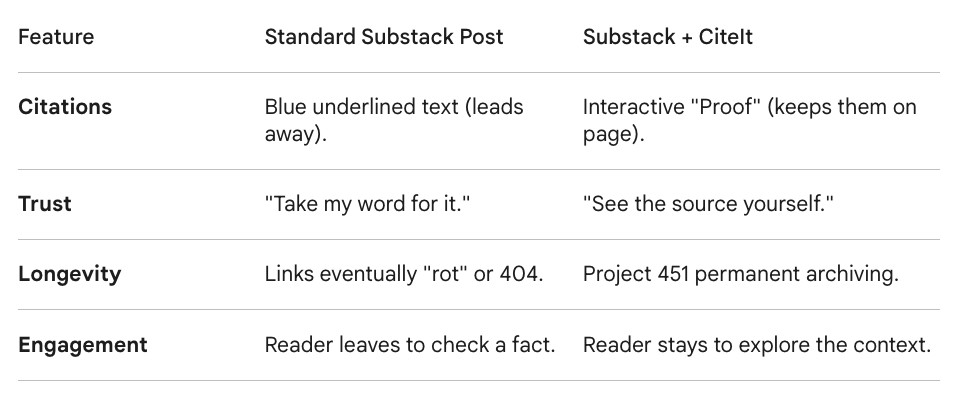
Before CiteIt vs After CiteIt
*
Project 451 is the name of Matt Taibbi's vision
for a
collective-memory archiving project that permanenly
preserves electronic readers' access to the works that they purchased, instead of allowing
readers to be turned into renters whose access to may be
censored, edited or withdrawn at any point in the future.
Platform FAQ: Frequently Asked Questions
Does this slow down page load times?
- "CiteIt is designed to be 'lazy-loaded.' It doesn't fetch the source data until a reader actually clicks or hovers, keeping your site speed lightning-fast."